
Online dating has evolved into a dynamic digital ecosystem with its own language, unwritten rules, and shorthand. Whether you are swiping on a global platform or navigating a niche app, understanding these 35 terms will help you decode modern dating culture, recognize manipulation tactics, and communicate with confidence in 2026. Before you master the vocabulary, it helps to start on the right platform — our ranked guide to the top 10 dating sites for 2026 covers which apps give you the best foundation for meaningful connections.
From emotional avoidance tactics like ghosting and breadcrumbing to relationship milestones like DTR and exclusive, this glossary covers the vocabulary shaping how we meet, flirt, and form connections online. You will also find essential safety terms to protect yourself from scams and digital risks.
Behavior Terms
These terms describe common dating behaviors — both healthy and problematic — that shape how people interact in online spaces.
Ghosting
Ending all communication with someone without any warning or explanation, often leaving the other person confused and without closure. It has become one of the most widespread ways people exit online relationships without confrontation.
Example: After weeks of daily chats, Alex stopped replying to Jamie’s messages with no explanation.
Breadcrumbing
Sending sporadic messages, likes, or flirty comments to keep someone interested without any genuine intention of pursuing a real relationship. It is a way to maintain someone’s attention and emotional investment without reciprocating it.
Example: Jordan liked Taylor’s photos every few days but never initiated a real conversation or suggested meeting.
Benching
Keeping someone as a potential backup option while dating others, maintaining just enough contact to stay relevant without investing seriously in that person.
Example: Sam kept texting Riley but went on dates with others, never committing to real plans.
Zombie-ing
When someone who previously ghosted you suddenly reappears in your messages or social media feed, acting as if nothing happened.
Example: After disappearing for four months, Jordan texted Taylor with “Hey, long time no see!” as if the ghosting had never occurred.
Soft Launch
Sharing hints of your dating life or new relationship on social media indirectly — often through vague stories or ambiguous photos — without making a formal announcement.
Example: Priya posted a sunset photo with a heart emoji, subtly suggesting she might be seeing someone new.
Icing
Replacing a real breakup with polite excuses or strategic avoidance, leaving a partner in emotional limbo without closure or honest communication.
Example: Mark stopped replying to Lucy’s messages but kept saying he was “too busy” whenever the relationship came up.
Slow Fade
Gradually reducing communication and emotional investment until contact naturally disappears, without a direct conversation or clean break.
Example: After their last date, Dana replied less and less frequently until Chris stopped reaching out altogether.
Love Bombing
Overwhelming someone with excessive affection, gifts, or romantic gestures early in a connection, often as a way to manipulate them into commitment before they have had time to evaluate the relationship critically.
Example: Within a week of matching, Alex sent Taylor daily love notes, expensive gifts, and constant declarations of love.
Mooning
Publicly expressing exaggerated admiration for someone on social media — through posts, stories, or comments — in a way that is visible to a wider audience than just the target.
Example: Jamie posted a 10-slide story titled “Why I’m Obsessed with Alex” complete with screenshots and heart-eyes memes.
Orbiting
Staying connected to someone’s social media after a relationship ends or fades — liking posts, watching stories, commenting — without resuming direct communication.
Example: Even after the breakup, Taylor still liked Riley’s old photos and watched every Instagram story.
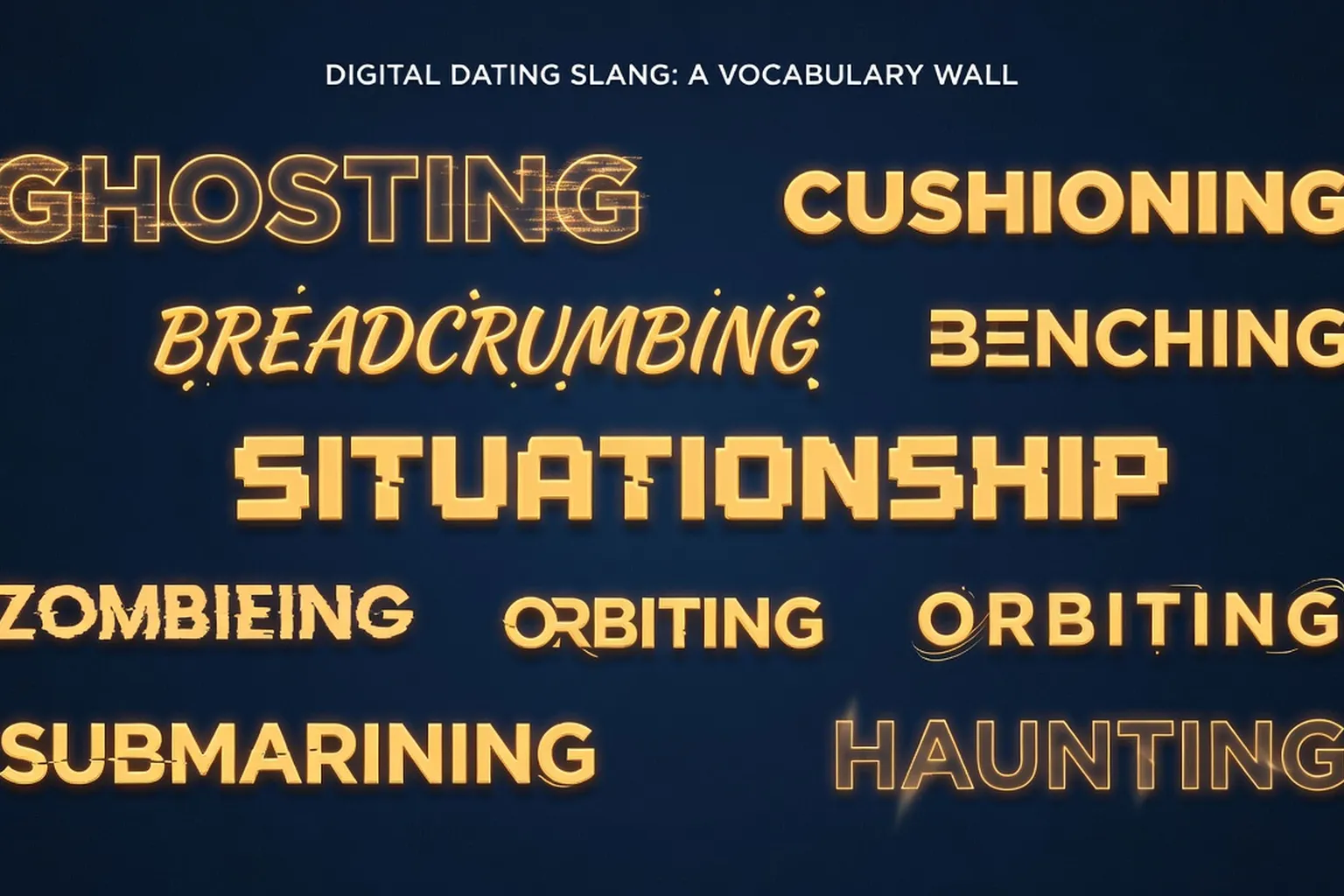
Shared vocabulary makes it easier to name a behaviour that would otherwise stay vague and unexamined.
Profile and App Terms
These terms relate to dating app features, profile strategies, and algorithmic mechanics that influence your online dating experience.
Understanding how these systems work is one side of the equation — the other is how you present yourself. Our guide on how to write a dating profile that attracts quality matches covers the profile side of every term in this section.
Swipe Right
A gesture on dating apps indicating interest in someone’s profile. Swiping right signals that you are open to connecting with that person and, if mutual, creates a match.
Example: Mia swiped right on Jake’s profile after seeing his love of hiking and indie music.
Swipe Left
The reverse of swiping right: rejecting a profile by swiping in the opposite direction, indicating no interest without any explanation.
Example: After reading Leo’s bio about disliking pets, Olivia swiped left, knowing she wanted an animal-loving partner.
Super Like
A premium feature on apps like Tinder that highlights your interest by notifying the other person you gave their profile extra attention beyond a standard swipe.
Example: When Emma saw Jake’s profile, she used a Super Like to signal she was especially interested.
Match
The result when two users both swipe right on each other’s profiles, enabling them to begin messaging. Matches are the entry point to all online dating conversations.
Example: When Liam and Sofia both swiped right, the app notified them of a match.
Shadow-Banning
A practice where a dating platform limits a user’s visibility without informing them, often in response to reports of suspicious behavior or guideline violations.
Example: After receiving multiple reports, Alex’s profile stopped appearing in other users’ feeds.
Boosting
A paid feature that temporarily increases a profile’s visibility to a wider audience, often most effective during peak usage hours.
Example: Taylor used a weekend boost and saw their profile appear at the top of nearby users’ feeds.
ELO Score
An algorithmic rating used by some platforms to rank users based on engagement and perceived attractiveness, influencing which profiles appear together in feeds.
Example: Jordan’s high ELO score meant their profile was shown more frequently to other highly active users.
Profile Stacking
Creating profiles on multiple dating apps simultaneously to maximize match opportunities or compare platform performance.
Example: To maximize options, Priya ran profiles on three apps, rotating attention based on where conversations were most active.
Catfishing
Creating a false online identity using stolen photos, fabricated details, or entirely invented backstories to deceive someone into an emotional connection.
Example: The profile claiming to be a model from Paris was using a photo stolen from a travel blog.
Digital Footprint
The collective data trail — posts, likes, interactions, public profiles — that a person leaves across social media and dating platforms, which can influence both dating success and personal security.
Example: When Alex searched Jordan’s name, they found old tweets and travel photos that formed a coherent picture of who Jordan actually was.
Relationship Stage Terms
These terms define the various stages of modern relationships, from initial contact through commitment, including the gray areas that characterize much of how relationships form online.
Understanding where you stand in a relationship often requires direct conversation — if any of these terms apply to your situation, our 25-point online dating safety checklist can help you identify whether patterns like love bombing or icing are present alongside the ambiguity.
Situationship
A relationship without a clear label or defined expectations, existing somewhere between casual dating and a committed relationship. Both parties are often aware of the ambiguity but avoid addressing it directly.
Example: Alex and Taylor spent weekends together and texted daily, but neither called it a relationship or discussed exclusivity.
Talking Stage
The early phase of getting to know someone through messages or casual meetings before any relationship label or exclusivity has been established.
Example: Jamie and Morgan had been “talking” for weeks, going to coffee and flirting over text, but neither had asked about the other’s intentions.
Exclusive
When two people agree to date only each other and stop seeing other people, marking the transition from casual connection to committed relationship.
Example: After two months of talking, Alex and Taylor decided to be exclusive and deleted their other dating apps.
Friends with Benefits (FWB)
A relationship that maintains friendship while including a physical component, without the commitment or expectations of a romantic relationship.
Example: Sam and Riley agreed to be FWB, keeping things casual and making sure both were on the same page about the arrangement.
DTR (Define The Relationship)
The conversation where two people explicitly clarify what their connection is — whether it is casual, exclusive, or heading toward commitment.
Example: After three weeks of intense texting, Jamie asked Alex directly: “Can we DTR? Is this becoming a relationship?”
Dry Dating
A period of intentional abstinence from sexual activity or romantic involvement, typically chosen for personal growth, emotional readiness, or after a difficult breakup.
Example: After her last relationship ended, Taylor entered a phase of dry dating to focus on herself before committing again.
IRL
Short for “In Real Life” — used to distinguish physical, in-person interaction from digital communication.
Example: After weeks of FaceTime calls, Alex and Jordan finally met IRL at a coffee shop downtown.
Rizz
Slang derived from “charisma” — referring to someone’s natural ability to attract, charm, or create immediate chemistry, especially in romantic or flirtatious contexts.
Example: Jordan has so much rizz that within five minutes of walking into a room, three people wanted to talk to them.
Ship
Short for “relationship” — commonly used by others to express hope or enthusiasm that two people will end up together, even if they are not yet officially a couple.
Example: After fans saw the two musicians performing together, they immediately started shipping them as a potential couple.
Slow Burn
A relationship that develops gradually over time, building deep emotional connection through consistent, steady interaction rather than immediate intense attraction.
Example: Their slow burn started with late-night study sessions and grew into a committed relationship over a year of careful, honest getting-to-know-each-other.

New terms keep appearing because the behaviours they describe were already common without a name.
Safety and Scam Terms
Staying safe in online dating means understanding the risks before you encounter them. Here are five terms that cover the most serious digital dangers you are likely to face:
- Romance Scam: A fraudulent scheme in which a scammer builds a fake romantic relationship to manipulate the victim into sending money, gifts, or personal information.
- Phishing: An attempt to trick someone into revealing personal information through fake messages, links, or websites designed to appear legitimate.
- Catfish: A person who creates and maintains a fake online identity to deceive others into believing they are interacting with a real, authentic individual.
- Sextortion: A blackmail scheme where someone coerces a person into sharing explicit images or videos and then threatens to distribute them unless compliance is provided.
- Identity Theft: The crime of stealing personal information to commit fraud, open accounts, or impersonate someone online.
Romance Scam
A fraudulent scheme in which a scammer builds a fake romantic relationship — often over weeks or months — to manipulate the victim into sending money, gifts, or personal information.
Example: A man claiming to be a doctor working abroad asked for emergency funds after expressing deep feelings within days of first contact.
Phishing
An attempt to trick someone into revealing personal information — passwords, credit card numbers, or login credentials — through fake messages, links, or websites designed to appear legitimate.
Example: After matching with someone, Taylor received a link to “verify their account,” which redirected to a page that stole their login credentials.
Catfish
A person who creates and maintains a fake online identity, using someone else’s photos and fabricated personal details, to deceive others into believing they are interacting with a real, authentic individual.
Example: The profile presenting as a professional athlete turned out to be someone using stolen photos from a fitness influencer’s public account.
Sextortion
A blackmail scheme where someone coerces a person into sharing explicit images or videos and then threatens to distribute them publicly unless a payment or other compliance is provided.
Example: After receiving intimate photos from Jordan, a scammer demanded $2,000 or threatened to post them to Jordan’s social network.
Identity Theft
The crime of stealing personal information — name, address, Social Security number, banking details — to commit fraud, open accounts, or impersonate someone online or in financial systems.
Example: After sharing a photo that accidentally included an ID document in the background, Taylor discovered accounts had been opened in their name.
Why This Glossary Matters in 2026
The language of modern dating evolves faster than most users can keep up with. Understanding these 35 terms gives you more than vocabulary — it gives you the ability to name what is happening in your own connections, recognize manipulation patterns before they escalate, and have clearer conversations with potential partners about where things stand.
Knowledge is the starting point, but applying it requires good judgment and experience. A professional matchmaker’s perspective on how these dynamics play out in practice is one of the most useful lenses available — our interview with matchmaker Rachel Kim on what dating apps get wrong addresses many of the patterns these terms describe from a professional standpoint.
The global expansion of online dating also means that these terms are increasingly crossing cultural and linguistic borders. For anyone navigating international connections, platforms that specialize in cross-cultural matching — like international online dating platform connecting people worldwide — provide an environment where these terms and their behavioral implications are well understood by the community using them.
Whether you are new to apps or a seasoned user, returning to this glossary periodically is worth the time. New terms emerge regularly, and the ones that endure tend to reflect something genuine about how human connection and digital behavior interact.