
- Massive global user base (500M+ registered)
- Free messaging with Encounters game
- Video chat available for free
- Works in over 190 countries
- Live streaming feature
- Interface feels outdated compared to competitors
- Heavy advertising in free tier
- Many inactive profiles in database
- Premium credits can add up quickly
- Less effective for serious relationships
Quick Verdict: 7.0/10
Badoo’s age and scale are simultaneously its greatest asset and its greatest liability. With over 500 million registered users across 190+ countries, it remains one of the most geographically comprehensive dating platforms on earth. But the interface design has fallen behind the current generation of dating apps, the advertising load in the free tier is intrusive, and the sheer volume of inactive profiles in the database dilutes the experience. It is a good tool in the right geographic markets; in others, better options exist. Score: 7.0 out of 10.
What Is Badoo?
Badoo was founded in London in 2006 by Russian entrepreneur Andrey Andreev. Over the following two decades, it grew to become one of the world’s largest social dating platforms, claiming over 500 million registered users across 190 countries — figures that, even heavily discounted for inactive accounts, represent a genuinely enormous community.
Badoo’s early growth was driven by aggressive expansion into markets that Tinder and other American-born apps were slow to enter — Eastern Europe, Latin America, Southeast Asia, the Middle East, and Africa. In many of these regions, Badoo established first-mover advantages that it still holds today despite increased competition.
- Encounters: Tinder-like swipe interface.
- Direct Messaging: Text-based conversation.
- Video Chat: Face-to-face interaction without leaving the app.
- People Nearby: Shows users in your immediate geographic area.
- Live Streaming: Broadcast to the Badoo community.
The company’s history has been complicated. Badoo’s founder was also an early investor in Bumble, creating a period of associated ownership and occasional confusion between the brands. A 2020 sale of Andreev’s stake in the Bumble parent company formalized the separation of the two platforms, which now operate fully independently.
In 2026, Badoo faces competitive pressure from all sides — Tinder in Western markets, Hinge for relationship-focused users, TikTok-inspired apps among younger users, and regional platforms in its stronghold markets. The company has been slower than competitors to modernize its interface and algorithms, and this inertia is visible in the user experience.
Registration and Profile Setup
Registering for Badoo is simple and can be accomplished via the website or mobile app. You can register with an email address, phone number, or social media login. The initial signup asks for your gender, date of birth, location, and what you are looking for — friendship, casual dating, or serious relationships. For a complete overview of the dating app landscape, our top 10 dating sites rankings give Badoo its proper competitive context.
Profile photo is the first required element after basic information. Badoo’s photo verification system, which has been in place for many years, asks you to take a specific pose with your camera that is then matched against your profile photo to verify you are a real person. This “selfie verification” is more mature and reliable than similar features on newer apps and has been refined through years of operation at scale.
Beyond the profile photo, Badoo encourages users to add up to six additional photos and complete a brief biography. Profile completion is incentivized through a profile strength indicator that shows how your profile compares to others in your area. Completing your profile thoroughly provides visibility benefits, though the platform’s algorithm is not as transparent about exactly how completion affects match recommendations.
The registration experience is slightly cluttered compared to newer apps — Badoo shows numerous prompts, ads, and feature introductions during the onboarding flow. This commercial pressure throughout the experience is one of the most notable ways the platform feels its age compared to cleaner competitors.
User Base and Geographic Reach
Badoo’s most genuine strength is its geographic reach. In Eastern European countries — Poland, Romania, Bulgaria, Czech Republic, Ukraine — Badoo has established user bases that rival or exceed Tinder in activity. The same is true in many Latin American countries, where Badoo was an early major platform and retains strong market share in countries like Mexico, Argentina, and Colombia.
In Western Europe, the picture is more mixed. France and Spain have strong Badoo communities. The UK and German markets have trended toward Tinder and Bumble in recent years, though Badoo retains users. North America is Badoo’s weakest major market — the platform has a user base but it is substantially smaller than Tinder’s in the United States and Canada.
This geographic variation matters practically. If you are in a region where Badoo is strong, the large active user base creates a genuinely useful platform experience. If you are in North America or Northern Europe, you may find better options. If you travel frequently to Latin America or Eastern Europe, maintaining a Badoo presence is worth the minimal effort of keeping a profile active.
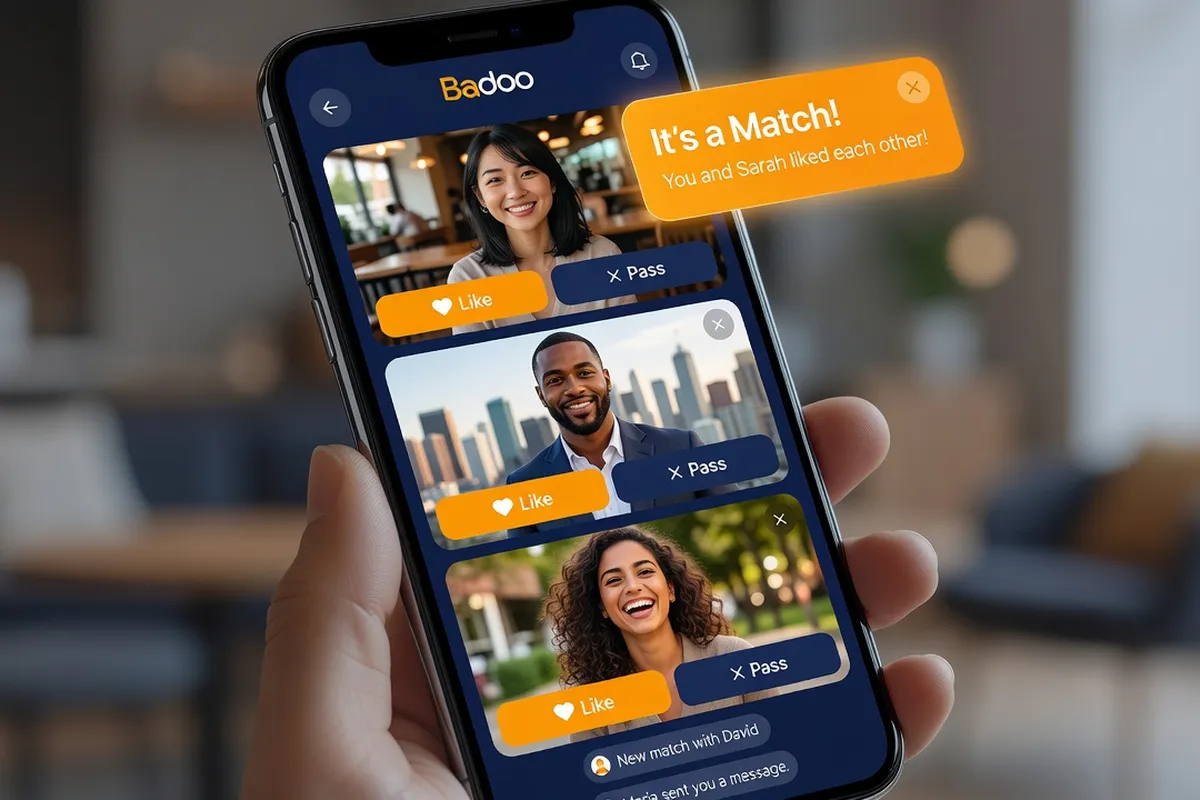
Reach across many countries is the platform's main asset, and it varies sharply by region.
For guidance on building a compelling profile that performs well across multiple platforms, see these tips on optimizing your dating profile which cover photo selection, biography writing, and first message strategies.
Features
The Encounters feature is Badoo’s most-used functionality and operates similarly to Tinder’s swipe interface. You are shown profiles one at a time and indicate interest with a like or a pass. Mutual likes create a connection that enables messaging. Unlike Tinder, Encounters connections on Badoo do not expire — a match remains accessible indefinitely. Users comparing mainstream swipe apps should also read our Tinder review for a head-to-head feature comparison.
Direct messaging is available free of charge for basic text exchanges. The messaging interface is functional if not particularly elegant. Video chat — accessible directly from any conversation — is available without a premium subscription, which distinguishes Badoo from apps like Tinder and Bumble where video calling requires premium membership. This is a genuine differentiator worth noting.
Badoo’s high volume of casual connections also means conversations frequently stall or vanish without explanation — a pattern that trips up daters who are not expecting it. For a deeper look at why matches go quiet and how to read the signals, see our interview with a relationship coach on ghosting and breadcrumbing.
The Live Streaming feature allows any user to broadcast video content to the Badoo community. Viewers can send virtual gifts (purchased with premium credits) to streamers they appreciate. This feature has driven engagement in some markets but creates a somewhat transactional atmosphere that sits uneasily with the romantic context of a dating platform.
The “People Nearby” feature shows users geographically proximate to your current location. This hyperlocal feature can be useful for travelers or for users interested in meeting people in their immediate neighborhood rather than their broader metropolitan area.
Pricing
Badoo operates a hybrid pricing model that combines a subscription option (Badoo Premium) with a virtual credits system for specific features.
- Removes advertising
- Shows who liked your profile before matching
- Provides unlimited Superswipes
- Enables advanced search filters including height, education level, and relationship intentions
- Cost: Approximately $10-15/month depending on your region
The credits system is used for specific high-visibility features: Spotlights (which place your profile at the top of search results in your area for 30 minutes) and Superswipes beyond the daily free allowance. Credits packages start at modest amounts and scale up. For users primarily interested in standard swiping and messaging, credits are largely optional. For users who want maximum visibility, credits can add $10-30 to monthly costs.
Safety
Badoo’s photo verification system is mature and effective at preventing the most basic forms of fake profile creation. The selfie-matching system has been refined over many years of operation at scale and is more sophisticated than similar features on newer apps. Our online dating safety guide provides detailed guidance on identifying fake profiles on high-volume social dating platforms.
The platform’s moderation infrastructure includes automated content review and a human moderation team. Given the scale of the platform — millions of active users daily — the moderation response times for reported content are inevitably slower than on smaller platforms. Expect 24-72 hours for responses to reports, versus the 12-24 hours typical of more focused platforms.
Standard precautions are essential on a platform of Badoo’s size: never share financial information, video chat before meeting in person, report suspicious profiles, and arrange first meetings in public places.
Our Experience After 30 Days
Testing Badoo over 30 days in a major Western European city and a North American city produced dramatically different results — illustrating how geographic variation defines the Badoo experience.
In the European city, the user base was substantial and active. Encounters generated multiple daily matches, conversations developed naturally, and the overall quality of the experience was comparable to Tinder in a market where Tinder is dominant. Badoo genuinely works well in markets where it is strong.
Match volume and profile density differed enough between the two test cities to change the experience entirely.
In the North American city, the experience was thinner. Fewer daily matches, more inactive profiles in the database, and a sense of the platform being a secondary choice for most users. The core product still worked, but the user base density that drives the best dating app experiences was lacking.
For travelers and internationally mobile users, Badoo’s geographic range is a genuine asset. For users based primarily in North America, newer alternatives generally outperform it.
Badoo vs Competitors: How It Stacks Up in 2026
Understanding where Badoo stands relative to its main competitors clarifies which scenarios make it the right choice. Regardless of which platform you choose, our how to write a dating profile guide will help you maximize your results.
| Feature/Aspect | Badoo | Tinder |
|---|---|---|
| Dominance | Strong in Eastern Europe, Latin America, parts of Asia | Dominates North America, Western Europe |
| Interface | Less modern | More modern |
| Video Chat | Free | Requires premium |
| Best Use | Primary in Badoo-dominant regions | Primary in Tinder-dominant markets |
| Feature/Aspect | Badoo | Bumble |
|---|---|---|
| Messaging | Open format | Women-first model |
| Market Strength | Higher match volume in strong markets | Higher conversation quality in strong markets |
| Best Use | High match volume | Quality conversations |
| Location | Strong in Eastern Europe, Latin America | Strong in major English-speaking cities |
Badoo vs Hily: Hily’s AI matching produces more relevant suggestions within a smaller pool. Badoo’s scale produces more suggestions within a less curated pool. For users who prioritize quality over quantity and are in markets with sufficient Hily density, Hily offers a better experience. For users who value geographic range and need a platform that works across dozens of countries, Badoo’s reach is unmatched.
When Badoo is the right choice: international travel across multiple regions, Eastern European or Latin American markets specifically, free video chat as a priority feature, or supplementing a primary platform in a new country.
When Badoo is not the right choice: users primarily based in North America or Northern Europe who want the best mainstream dating app experience in those markets, users seeking serious long-term relationships (specialized platforms outperform), or users who need a modern and visually polished interface.
The strategic use of Badoo in 2026 is as part of a multi-platform approach for internationally mobile users rather than as a primary platform in markets where more focused alternatives deliver better results.
Frequently Asked Questions
Is Badoo free? Badoo is free to use with basic features including Encounters (like/dislike swiping), messaging, and video chat. Premium features (Badoo Premium) are available for around $10-20/month.
Is Badoo safe to use? Badoo has photo verification and reporting tools, but the sheer size of the platform means fake profiles exist. Use standard online dating safety practices: never send money, video chat before meeting.
How does Badoo compare to Tinder? Badoo has more global users but a less polished interface. Tinder dominates in North America and Western Europe. Badoo is more popular in Eastern Europe, Latin America, and parts of Asia.
Does Badoo own Bumble? Badoo’s founder Andrey Andreev was an early investor in Bumble, but the two platforms operate independently. As of 2020, Andreev sold his stake in Bumble’s parent company.
What is Badoo Premium? Badoo Premium removes ads, shows who liked you, gives unlimited Superswipes, and enables advanced search filters. It costs approximately $10-15/month depending on your region.
Badoo's scale is unmatched, but its age shows. It works best as a casual platform for users in countries where newer apps have not yet gained traction. For serious relationships, newer apps offer a better experience.
For more resources, visit tips on optimizing your dating profile.