
Every day, millions of people open dating apps hoping to find a genuine connection. And every day, a significant number of them encounter profiles that are not what they appear to be. Fake accounts, bots, and sophisticated romance scammers have become a permanent fixture of online dating — and in 2026, their tactics are more refined than ever.
Understanding how to spot a fake dating profile is no longer optional. It is a core skill for anyone navigating modern dating, whether you use Tinder, Bumble, Hinge, Match, or any international dating platform. The good news is that scammers tend to follow predictable patterns. Once you know what to look for, the warning signs become difficult to miss.
Introduction: The Scale of Fake Profiles in 2026
| Year | Source | Reported Losses |
|---|---|---|
| 2022 | FTC | $1.3 billion |
| 2023 | FBI IC3 | Nearly $900 million |
Experts believe the true figure is far higher because most victims never report.
These numbers represent real people: individuals who invested not just money but weeks or months of emotional energy into a relationship that never existed. The median individual loss reported to the FTC was $4,400 — but many victims lost tens of thousands of dollars, and some lost their entire life savings.
What has changed in 2026 is the sophistication of the deception. AI-generated profile photos now produce images indistinguishable from real people. Large language models allow scammers to maintain convincing, grammatically correct conversations across time zones without native fluency. Deepfake video tools mean that even a “live” video call is no longer a guarantee of authenticity.
Despite these advances, fake profiles still leave traces. The underlying psychology of manipulation has not changed, and neither have the practical constraints scammers face. Recognizing the patterns — in photos, bios, communication styles, and behavior — remains your most reliable defense.
Red Flags 1–5: Profile Photo Warning Signs
Photos are the first layer of a dating profile, and they are often where a fake account reveals itself most clearly. Here is what to watch for.
Spotting fake profiles is just one layer of protection — our complete online dating safety guide covers everything from secure messaging to safe in-person meetings.
Red Flag 1: Suspiciously Professional or Studio-Quality Photos
- Casual snapshots
- Group shots with friends
- Occasional polished images
When every photo looks professionally taken, it raises suspicion as scammers often use stolen images from influencers or models.
Red Flag 2: Only One or Two Photos
A genuine person who has been on this planet for thirty years has more than two photos of themselves in existence. A profile with a single photo, or with only two nearly identical images, suggests either a freshly created fake account or someone who does not want multiple angles scrutinized. The fewer the photos, the harder it is to reverse image search, and the less information you have to detect inconsistencies.
Red Flag 3: No Candid or Social Photos
Authentic profiles typically include at least one candid photo — someone at a barbecue, on a hiking trail, at a birthday party. Fake profiles almost universally lack these. The photos they use are professionally shot or sourced from social media accounts that themselves tend toward staged aesthetics. If there are zero photos with identifiable friends, family, or ordinary social contexts, pay attention.
Red Flag 4: Photos That Do Not Match the Stated Age
A profile claiming to be 42 years old but whose photos show someone who looks 25 is waving a large warning flag. Scammers sometimes use photos of people significantly younger than the age they claim, either because they sourced the photos carelessly or because they believe youthful attractiveness improves their chances. Inconsistency between stated age and apparent age in photos deserves immediate scrutiny.
Red Flag 5: All Photos Have the Same Backdrop or Setting
Real people exist in multiple environments over the years. When all of a profile’s photos appear to be taken in the same location — the same room, the same outdoor setting, or clearly the same day — it suggests the photos came from a limited source, such as a single stolen social media post or a small batch of model photos. Variety in backgrounds and settings across multiple years is a hallmark of genuine profiles.
Red Flags 6–10: Bio and Communication Patterns
Beyond photos, the written content of a profile and the early stages of communication reveal just as much about authenticity.
Red Flag 6: A Bio That Reads Like a Template
“I love travel, sunsets, good wine, and deep conversations. Looking for my partner in crime.” This bio could belong to virtually anyone — which is precisely why it belongs to no one in particular. Genuine people write specific things: they mention the city where they grew up, the team they support, the book that changed their outlook, the specific cuisine they cook on Sundays. Vague, universally appealing bios stripped of any identifying detail are a classic feature of fake profiles designed to attract as many people as possible.
Red Flag 7: Claims a High-Status, Hard-to-Verify Profession
Military officer stationed overseas. Petroleum engineer on an offshore rig. Doctor with Doctors Without Borders. Successful businessman traveling in Europe. These professions appear with disproportionate frequency in romance scam profiles — and for good reason. They explain why the person cannot meet in person, why they might need financial help in an emergency, and why they live an exciting, mobile lifestyle. When a profile’s stated profession makes meeting up conveniently impossible, treat it as a deliberate structural choice rather than a coincidence.
Red Flag 8: Immediate and Intense Emotional Connection
Legitimate relationships develop at a human pace. Scammers, working on a schedule and often running multiple cons simultaneously, accelerate emotional intimacy dramatically. Within days — sometimes within hours — they are declaring that you are unlike anyone they have ever met, that they feel a deep spiritual connection, that they may be falling in love. This technique is called “love bombing,” and it is designed to bypass your critical thinking by overwhelming you with positive emotion and manufactured intimacy before you have had time to assess the relationship rationally.
Red Flag 9: Immediate Pressure to Move Off the Platform
Dating platforms have fraud detection systems. Scammers know this. They routinely try to move conversations to WhatsApp, Telegram, or email as quickly as possible, often within the first few messages. The stated reason is usually something appealing — “I check this app rarely,” “it’s easier to reach me on WhatsApp,” “I’d love to text you directly.” The real reason is that off-platform communication is harder to monitor, flag, or use as evidence in a report.
Red Flag 10: Grammar and Writing Inconsistencies
AI tools have dramatically improved scammer writing quality in 2026, but inconsistencies still emerge. Watch for sudden shifts in writing style — eloquent messages followed by oddly constructed sentences. Watch for messages that seem to answer a slightly different question than the one you asked, suggesting templated responses. Watch for cultural references or idioms that feel slightly off for the claimed nationality. And watch for messages that arrive at unusual hours if the claimed location is in the same time zone as you.
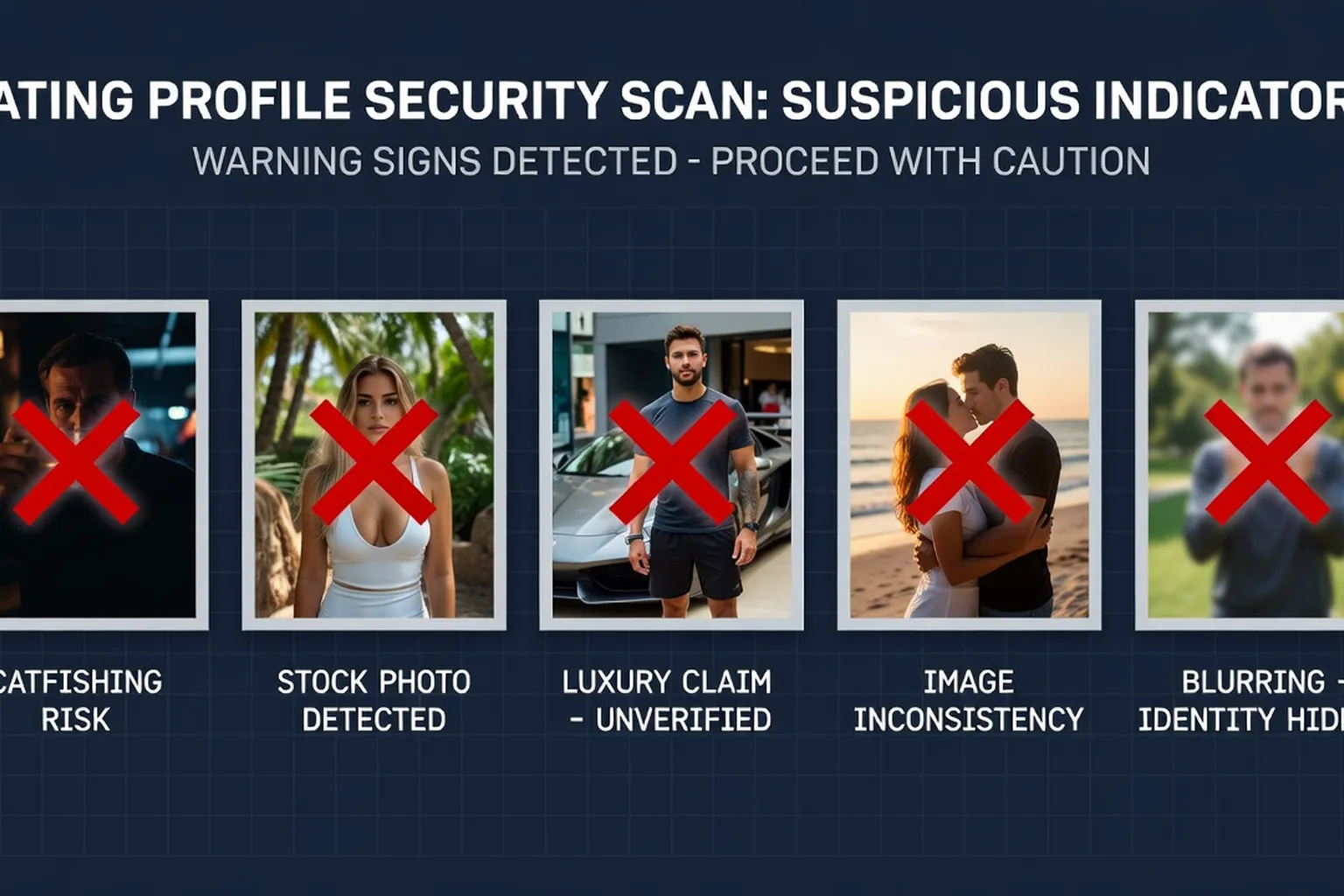
Templated answers and off-key idioms tend to surface once you compare several messages side by side.
Red Flags 11–15: Behavioral Red Flags Over Time
Some red flags only become visible after several conversations. These behavioral patterns are among the most telling.
Not all platforms are equal in fighting fake accounts — see how VictoriaBrides handles profile verification to understand the identity verification process on one of the most scrutinized international sites.
Red Flag 11: Refusal or Avoidance of Video Calls
In 2026, requesting a live video call within the first week of messaging is completely normal and socially acceptable. Anyone genuinely interested in a romantic connection will understand this request and accommodate it. A person who consistently refuses, postpones, or finds excuses to avoid video calls — bad internet connection, broken camera, inconvenient time zones that somehow never resolve — is almost certainly hiding something about their actual appearance.
Note: deepfake video is increasingly accessible, so a video call is not an absolute guarantee. Ask the person to perform a specific action in real time (wave with their left hand, hold up three fingers, turn their head to show their left ear) to verify that the video is truly live and not a pre-recorded or AI-generated stream.
Red Flag 12: Story Inconsistencies Across Conversations
Scammers managing multiple victims often lose track of what they have told specific individuals. Early in your conversations, note specific details: the name of their sibling, where they went to university, the city where they grew up, what happened on their last birthday. If these details change in later conversations — without a clear explanation — you are likely dealing with someone working from a script and maintaining multiple simultaneous personas.
Red Flag 13: Any Request for Money, Gift Cards, or Cryptocurrency
This is the clearest and most unambiguous red flag of all. No matter how compelling the story — a medical emergency, a business opportunity requiring temporary funds, plane tickets to come visit you, a customs fee to retrieve a package — a person you have never met in person should never be asking you for money. Romance scammers are patient; they may spend weeks or months building trust before making a financial request. But the financial request is always the destination. If it arrives, the relationship was never real.
Red Flag 14: They Have No Verifiable Online Presence
In 2026, virtually every adult has some form of verifiable digital footprint — a LinkedIn profile, Facebook account, Instagram, or even just an old school alumni listing. When a person who claims a specific name, profession, and location produces zero results in a thorough search, that absence is itself significant. Real people are findable. If someone claims to be a physician in a specific city but has no LinkedIn, no hospital directory listing, no alumni record, and no social media presence whatsoever, the claimed identity likely does not exist.
Red Flag 15: Emotional Manipulation When You Ask Questions
A common scammer tactic when their cover is questioned is to respond with emotional manipulation rather than evidence. They express hurt that you do not trust them. They suggest your suspicion is a character flaw — that you have been “damaged” by past relationships. They become angry or withdraw affection as punishment for your doubt. A genuine person, when asked a reasonable verification request, will understand and comply. Only someone with something to hide responds to reasonable questions with emotional pressure.
How Fake Profiles Operate: The Romance Scam Playbook
Understanding the mechanics of a romance scam helps you recognize the pattern before it reaches its conclusion.
- Profile Creation: Using stolen photos and a fabricated biography.
- Initial Contact: Sending messages to multiple targets.
- One-on-One Communication: Moving to private messaging channels.
- Grooming Phase: Building emotional intimacy.
- Crisis Narrative: Introducing urgent financial needs.
- Financial Requests: Continuing until suspicion or resource depletion.
- Disappearance: Scammer blocks the victim across all channels.
The “grooming” phase begins. They invest significant time learning about the target’s life, desires, and vulnerabilities. They mirror the target’s values and interests. They create emotional intimacy through daily communication, virtual gifts, and romantic language. This phase can last weeks or months, depending on the scammer’s patience and the target’s level of skepticism.
A crisis narrative is then introduced. An accident requiring surgery. A business deal gone wrong requiring a temporary loan. A shipping container held in customs. A visa application fee. The details vary, but the structure is consistent: an urgent need for money that only you, as someone who cares for them, can help resolve.
Victims who comply are often asked for additional funds under new pretexts. This continues until the victim runs out of resources or grows suspicious enough to stop. The scammer then disappears completely, often blocking the victim across all channels.
The psychological aftermath is profound. Victims report not only financial devastation but deep shame, grief, and difficulty trusting others in subsequent relationships. Understanding this playbook is not just about protecting your bank account — it is about protecting months of your emotional life.
Tools to Verify a Dating Profile Identity
The most powerful tool available to anyone evaluating a suspicious profile is reverse image search. Here is how to use the most effective options.
How you open a conversation can also signal vulnerability to scammers — how to write a first message that avoids triggering scam responses explains what genuine first messages look like and how they differ from bot-bait.
Google Images
On a desktop browser, right-click on the profile photo and select “Search image with Google” or “Copy image address.” Go to images.google.com, click the camera icon, and paste the URL or upload the saved image. Google will show you all web pages where that image appears. If it shows up on a modeling portfolio, a stock photo site, or a different social media profile with a different name, the account is almost certainly fake.
On mobile, take a screenshot of the profile photo, then open the Google app and use the Google Lens feature to search by image.
TinEye
TinEye (tineye.com) specializes specifically in reverse image search and maintains its own indexed database of images. It is particularly useful for finding older images that may not appear in Google’s results. Upload the photo directly from your device for best results.
Yandex Images
Yandex (yandex.com/images) is underused by English-speaking users but is exceptionally powerful for finding images from Eastern European, Russian, and Central Asian social media platforms — regions where romance scam operations are disproportionately concentrated. If someone claims to be from Ukraine, Russia, Belarus, or Kazakhstan, Yandex image search will often surface the original source of stolen photos that Google misses entirely.
FaceCheck.ID
FaceCheck.ID is a facial recognition search engine specifically designed for this use case. Upload a photo and it searches social media platforms, websites, and news sources for the same face. It is significantly more effective than standard image search for finding a face when the photo itself has been modified (cropped, filtered, or color-adjusted to defeat exact image matching).
Social Catfish
Social Catfish (socialcatfish.com) is a paid service designed specifically for identity verification in online dating contexts. It searches across dating profiles, social media, and public records simultaneously. It is worth using when you have become emotionally invested in a conversation and want a thorough verification before going further.
Manual LinkedIn and Social Media Search
Search the person’s claimed full name alongside their claimed city and profession on LinkedIn. Search on Facebook. Search on Instagram. A real engineer in Chicago named James Hartwell who graduated from Northwestern in 2009 will leave traces. If absolutely nothing surfaces, that absence is evidence.

A reverse image search takes seconds, and an absence of any online trace is itself a form of evidence.
Platform-Specific Scam Patterns
Different dating platforms attract different types of fraudulent activity. Knowing the patterns on each platform helps you calibrate your vigilance appropriately.
Tinder Bots
Tinder has a persistent bot problem. These automated accounts match with users and immediately send a message with a link — often to an external website, game, or “private photo gallery.” The message is usually flirtatious and designed to provoke curiosity. Any account that sends a link within the first one or two messages is almost certainly a bot. Do not click the link. Report and unmatch immediately.
More sophisticated Tinder scams involve human operators who engage in several days of conversation before introducing a “can’t miss” investment opportunity, usually in cryptocurrency. These scams, sometimes called “pig butchering,” have cost victims hundreds of thousands of dollars each.
Bumble
On Bumble, where women make the first move, common scam patterns involve accounts that respond to initial messages with requests to continue the conversation on WhatsApp or another platform. The transition request often comes before even basic biographical information has been exchanged. Another common Bumble pattern involves accounts that seem to be responding from a script — answers that are slightly too generic and do not directly engage with what you actually wrote.
Hinge and Match
On relationship-focused platforms like Hinge and Match, scammers tend to be more patient and invest more time in relationship building. They understand that the user base is looking for something serious, so they present themselves as serious candidates. The warning signs here are subtler: the overly polished narrative, the suspiciously perfect compatibility, the profession that makes regular video calls impossible, the gradual introduction of financial difficulties.
International Dating Sites
Platforms that cater to international dating — whether connecting users across continents or focusing on specific regions — present a specific set of challenges. The legitimate difficulty of meeting someone who lives far away creates a natural cover for scammers who intend never to meet at all.
On international platforms, watch specifically for: requests for visa fees or travel document costs, “business emergencies” requiring money transfers, offers to visit you contingent on your sending funds for travel, and claims of love that arrive before any real-world meeting has been planned in concrete terms.
It is worth noting that genuine international connections do happen, and international travel and meeting genuine people abroad remains one of the most rewarding experiences modern mobility offers. The goal is not to avoid international connections but to verify them with the same tools you would apply to any profile — reverse image search, video calls, consistent story verification, and a firm refusal to send money to anyone you have not met in person.
Paid Messaging Sites
Some legacy dating platforms, particularly those targeting men seeking international partners, use a “paid messaging” model where users pay per message sent or received. On these platforms, a specific scam involves hired “correspondents” — real people paid to maintain romantic correspondence with paying members, with no intention of ever meeting or pursuing a genuine relationship. Signs include extremely rapid response times at all hours, messages that are beautifully written but slightly generic, and resistance to migrating to free communication channels.
What to Do If You’ve Been Catfished
Discovering that someone you have been emotionally invested in does not actually exist is a genuine psychological trauma. Here is a clear, practical path forward.
For a professional’s perspective on spotting low-quality or deceptive profiles, read what a professional matchmaker sees in app profiles — Rachel Kim’s insights are especially useful for avoiding common traps.
Cut All Contact Immediately
Block the account on every platform and channel where you have communicated. Do this without warning the scammer — telling them you know gives them an opportunity to shift tactics and attempt to maintain the connection under a different framing. Cut all contact completely and simultaneously.
Do Not Send Any Additional Money
Regardless of any story the scammer tells after you become suspicious — even a genuinely heart-wrenching emergency scenario — do not transfer any further funds. Scammers who feel a victim slipping away often escalate with increasingly dramatic crisis narratives. These are tactics, not reality.
Preserve All Evidence
Before deleting anything, take screenshots of the profile, the conversation history, any photos exchanged, and any payment records. Save usernames, phone numbers, and email addresses. This documentation is essential for both the platform report and any law enforcement filing.
Seek Emotional Support
Being catfished is not a reflection of your intelligence or emotional health. These operations are professionally designed to exploit normal human psychological needs for connection, trust, and love. Speak with someone you trust. Consider speaking with a therapist who has experience with fraud trauma. Organizations like the Cyber Civil Rights Initiative and the AARP Fraud Watch Network offer support resources specifically for romance scam victims.
Reporting Fake Profiles: A Step-by-Step Guide
Reporting matters. Your report may prevent the same scammer from victimizing others, and it contributes to the data that platforms and law enforcement use to identify and disrupt fraud operations.
- Tinder: Go to the profile, tap the flag icon, select “Report.”
- Bumble: Tap the three-dot menu on the conversation, select “Block & Report.”
- Hinge: Open the profile, tap the three dots, access the Report option.
Provide as much detail as possible in the report form.
Every major platform has a reporting mechanism. On Tinder, go to the profile, tap the flag icon, and select “Report.” On Bumble, tap the three-dot menu on the conversation and select “Block & Report.” On Hinge, open the profile and tap the three dots in the upper right corner to access the Report option. Provide as much detail as possible in the report form.
Step 2: Report to the FTC
File a report at reportfraud.ftc.gov. The FTC compiles reports to identify patterns, pursue enforcement actions against fraud networks, and publish data that helps the public understand the scale of the problem. Filing takes approximately ten minutes and requires the scammer’s contact information and a brief description of what occurred.
Step 3: Report to the FBI’s Internet Crime Complaint Center
File a complaint at ic3.gov. The IC3 accepts reports from victims of internet-facilitated crime and shares information with law enforcement agencies at the federal, state, and local levels. If you have transferred money, a report to the IC3 is particularly important — in some cases, rapid reporting enables recovery of wire transfers.
Step 4: Report to Your Bank or Payment Service
If you transferred money via bank wire, contact your bank’s fraud department immediately. If you used a gift card, contact the retailer who issued the card. If you used a cryptocurrency platform, contact their fraud team. The window for any recovery is narrow, but acting quickly gives you the best chance.
Step 5: Report to the Social Media Platform Where Photos Were Stolen
If you have identified the original source of the scammer’s stolen photos — for example, a real person’s Instagram account — consider alerting that person. They may not know their images are being used this way, and they may take their own action to help expose the scammer.
Conclusion
Fake dating profiles are a persistent feature of online dating, but they are not an inevitable one. The scammers who create them depend on you not knowing what to look for. They rely on the hope that emotional investment will override rational assessment — that by the time you notice the inconsistencies, you will be too invested to act on what you see.
The fifteen red flags in this guide are not obscure or subtle. They are consistent patterns that appear across platforms, across countries, and across the full spectrum of romance scam operations, from low-effort bot accounts to months-long sophisticated cons. Checking for these patterns is not a sign of cynicism about online dating — it is the reasonable, appropriate due diligence that any serious dating platform user should apply.
Run the reverse image search. Insist on a video call within the first week. Note the details of their story and check for consistency. Trust the timeline of normal human relationship development rather than allowing artificial urgency to accelerate your emotional investment. And if money ever enters the conversation, treat it as the serious warning sign it is.
Online dating works. Millions of people have found genuine, lasting relationships through the platforms discussed in this guide. The goal of staying alert to fake profiles is not to become suspicious of everyone — it is to protect the genuine connections that make the whole endeavor worthwhile. Readers wanting a broader, French-language perspective on avoiding scams while pursuing serious international relationships may also find this resource on safe international matchmaking a useful companion read.