
The average dating app user spends less than eight seconds deciding whether to reply to your opening message. That window is shorter than most people assume, and it forces a brutal reality: your first message is not a warm-up. It is the audition itself.
Most people know this in theory but still send “Hey” or “How was your weekend?” because they don’t know what else to do. This guide solves that. You will learn what the data says about response rates, how to read a profile before writing a word, the exact formulas that work, and 10 real opening messages — including the reasoning behind every single one.
Why Your First Message Matters More Than You Think
Dating apps are asymmetric environments. On most platforms, both people swipe right before a conversation opens. That means by the time you send your first message, you already have permission to talk. The conversation starter should not squander that permission.
Research consistently shows that the vast majority of conversations on dating apps never get past the first exchange. Matching is easy; converting a match into a real conversation is not. The opening message is the single largest variable you control in that conversion.
Think of it this way. Two people with identical profiles, identical photos, and identical attractiveness will have dramatically different response rates if one sends a personalized opening message and the other sends a generic one. The message is not a formality. It is the thing that separates people who go on dates from people who collect matches they never speak to.
Response rate also signals quality. When someone replies quickly and with substance, it indicates genuine interest. A reply you earned with a thoughtful opener is more likely to lead to a real date than one extracted from a pity response to “Hey, you’re cute.” The investment starts here.
There is also a compounding effect worth noting. The tone you set in your first message frames the entire conversation. Open with something playful and you invite playfulness back. Open with something earnest and specific and you invite the same. Your opening message is not just a greeting — it is an invitation to a particular kind of conversation.
The 3 Fatal Mistakes Most People Make (Data-Backed)
- Mistake 1: The generic opener.
- Mistake 2: The compliment without substance.
- Mistake 3: The overwhelming paragraph.
Before you craft the perfect opener, make sure your own profile is compelling — learn how to write a dating profile that attracts quality matches to maximize your reply rate.
Mistake 1: The generic opener. “Hey,” “Hi there,” “What’s up?” and “How was your day?” are the most commonly sent opening messages on every major platform. They are also the messages with the lowest response rates. Why? Because they give the recipient nothing to respond to. There is no hook, no signal that you read the profile, and no question that opens a specific door. The recipient has to do all the conversational work, and most people will not bother.
According to a Pew Research Center study on online dating, a significant portion of online daters report feeling overwhelmed by the volume of messages they receive. In that context, a generic message blends into the noise immediately.
Mistake 2: The compliment without substance. “You’re really beautiful,” “I love your smile,” and “You seem amazing” feel flattering to write but rarely generate replies. Appearance-based openers tell the recipient that you looked at their photo, not their profile. They also put the conversation on a superficial track from the start, which makes it harder to build real connection.
Mistake 3: The overwhelming paragraph. Some people overcompensate for generic openers by writing an essay. Three paragraphs about themselves, a detailed explanation of why they swiped, and five questions stacked on top of each other. This is just as ineffective as “Hey” but for the opposite reason. It creates pressure. The recipient feels obligated to write an equally long response, and most of them will not.
The pattern across all three mistakes is the same: the sender is not thinking about what it is like to receive the message. The best opening messages are written from the recipient’s perspective, not the sender’s.
How to Read a Profile Before Messaging
- Specific detail: Look for unique elements in photos or bios.
- Shared point of entry: Identify common interests or experiences.
- Interesting question: Formulate a question that invites an engaging response.
Look at the photos carefully. Not just the main photo, but all of them. Is there a photo from a specific location? A sport or hobby they are actively doing? A book on a shelf, a pet in the background, a restaurant you recognize? These are gold. They are things the person cared enough to photograph and post, which means they care about them. Referencing a specific photo detail immediately signals that you looked past the obvious.
Read every word of the bio. Many people write bios that feel throwaway, but nearly every bio contains at least one specific detail. A favorite TV show, a travel destination they mention, a food they love or hate, an unusual hobby, a job they describe in a specific way. These are the hooks you are looking for.
Note the prompts. On Hinge especially, the prompts are often the best material you have. If someone wrote a witty answer to a prompt, respond to that wit specifically. If they filled out a prompt about their love language or their unpopular opinion, those are openings to a real conversation.
Identify what is unique. Ask yourself: what is the one thing about this profile that I would not find in ten other profiles? That unique thing is almost always the right thing to reference in your opening message. It signals that you are not copy-pasting the same message to everyone, which is one of the most powerful signals you can send.
If a profile has no bio and only photos, you are not without options. You can reference something in a photo directly, ask a question about their apparent lifestyle, or use one of the formulas below that works even without a detailed bio.
The Golden Formula: Short, Specific, Curious
The single most effective framework for a first message can be compressed into three words: short, specific, curious.
Your messaging success also depends on choosing the right platform — see the top 10 dating sites ranked for 2026 to match your goals with the best app.
Short means your message is two to three sentences, ideally under 50 words. Short messages are easy to respond to. They do not create pressure. They communicate that you are confident enough to say something interesting without writing a monologue.
Specific means you reference something concrete from the profile. Not “I like your photos” but “That photo from the Norwegian fjords — did you hike in or take a boat?” Not “You seem fun” but “I noticed you listed three separate cities as home — do you actually live in all of them or is that aspirational?” Specificity is what separates a message that feels targeted from one that feels copy-pasted.
Curious means you end with a genuine question. Not a rhetorical one. Not five questions stacked together. One real question with an interesting answer. The question should be open-ended enough that a one-word reply would feel incomplete. “Do you like hiking?” can be answered with “yes” and closed. “What’s the most underrated hike you’ve done?” opens a conversation.
When you combine these three elements, you get a message that is easy to receive, hard to ignore, and naturally leads somewhere. Every formula and example in this guide is a variation on this core structure.
5 Opening Message Formulas That Work on Any App
These five formulas are adaptable to any platform and any profile type. Each one follows the short-specific-curious framework but applies it in a different way.
Formula 1: The specific photo reference. Pick one photo that stands out. Name what you see, add a single genuine reaction, and ask a question that opens the story behind the photo. Structure: “I saw the [specific thing in photo]. [Brief genuine reaction]. What was the story behind that?”
Formula 2: The bio hook. Take one specific detail from the bio and build a question around it. This works especially well when the bio contains something unusual or unexpected. Structure: “Your bio mentions [specific thing]. I’m genuinely curious — [question that invites a story, not a yes/no answer].”
Formula 3: The honest observation. This one is slightly more vulnerable and works well for people who want to avoid feeling too performative. Name something you found genuinely interesting about the profile and say why. Structure: “Most profiles list the same three hobbies, but yours mentions [specific thing] and I haven’t stopped thinking about what that says about a person. What pulled you toward that?”
Formula 4: The shared connection. If you genuinely share something with the person — a city, a food passion, an unusual interest, a book — open with that. Shared points of entry are among the strongest conversation starters because they bypass small talk entirely. Structure: “You listed [shared thing]. [Brief personal connection to it]. What got you into that?”
Formula 5: The playful challenge. This one works best on apps with a more casual, playful tone like Tinder. Take something from the profile and turn it into a lighthearted challenge or debate. Structure: “Your [opinion/preference] is controversial and I’m here for it. Defend yourself: [playful question about it].”
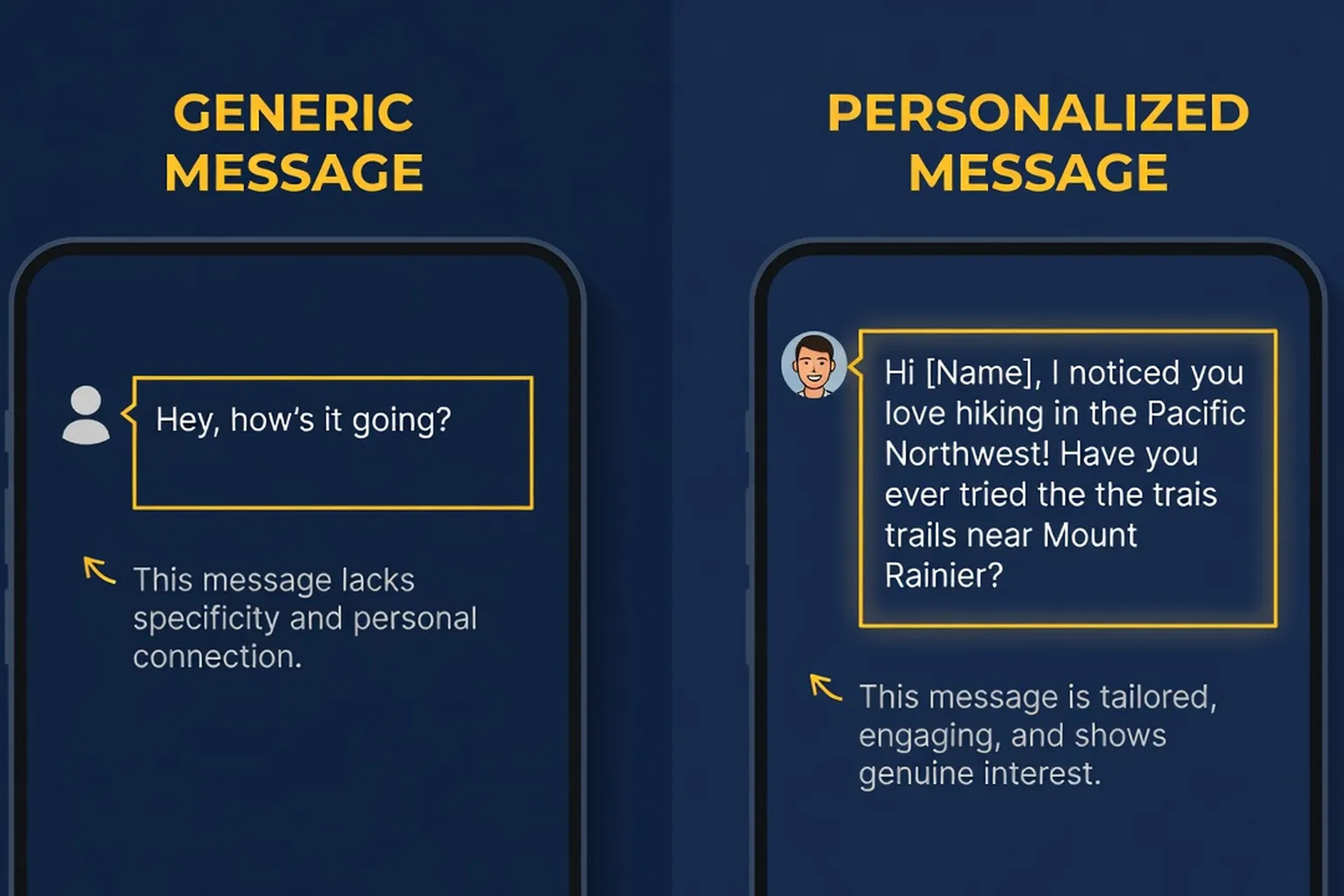
The difference between a generic opener and a personalized one is visible before anyone replies.
10 Real Examples (With Analysis of Why They Work)
These ten examples are modeled on real opening messages that generated strong reply rates. Each one is annotated so you understand the mechanics, not just the template.
Example 1: “That photo from the Amalfi Coast — is that the lemon sorbet everyone talks about or did you find something better?”
Why it works: Specific photo reference, shows you know something about the destination (adds credibility), ends with a question that invites either a fun food recommendation or a travel story.
Example 2: “Your bio says you can recommend a restaurant in any city on earth. I’m going to hold you to that — best place for ramen outside of Japan?”
Why it works: Directly engages a stated skill or claim from the bio, creates a low-stakes game around it, the question is specific enough to be interesting.
Example 3: “I noticed you listed ‘competitive trivia’ as an interest. That’s either a red flag or the most attractive thing I’ve read today. Which team are you usually on?”
Why it works: Takes an unusual detail, frames it humorously with a real compliment embedded inside the joke, ends with a question that invites playfulness.
Example 4: “Three photos in Rome and one in Bangkok — you seem to be testing something. What’s the actual dream destination you haven’t gotten to yet?”
Why it works: Shows you looked at multiple photos and spotted a pattern, the observation feels insightful rather than creepy, the question invites a real aspiration rather than a past fact.
Example 5: “The puppy in your third photo has better posture than I do. What’s his name and what’s his training secret?”
Why it works: Self-deprecating opener (not fishing for reassurance, just warm), focuses on something the person clearly loves, two small questions that are easy to answer.
Example 6: “You mentioned you’re learning Portuguese. Are you at the ‘ordering coffee confidently’ stage or the ‘accidentally insulting someone’ stage?”
Why it works: Engages a current activity rather than a fixed identity, the two stages framed humorously give them an easy entry point without requiring a monologue.
Example 7: “Your book shelf in the background has me curious — I can see the Murakami but the spine to its left is too blurry. What is it?”
Why it works: Extremely specific observation that signals genuine attention, creates a small mystery, the question is easy to answer and opens a book conversation naturally.
Example 8: “You listed hiking, cooking, and traveling as hobbies, which is exactly what everyone lists. Then I got to the ‘competitive cheese tasting’ part. Tell me everything.”
Why it works: Acknowledges the generic items with gentle humor (not mean), pivots hard to the specific and unusual detail, the request (“tell me everything”) is open and inviting without being a specific question they can dodge.
Example 9: “I’m usually skeptical of people who claim their dog is their best friend but your second photo is genuinely convincing evidence. Where do you two go on weekends?”
Why it works: Playful skepticism followed by a compliment, pivots to a lifestyle question that invites them to paint a picture of their actual life.
Example 10: “Your bio ends with ‘ask me about the time I accidentally ended up on a cooking show.’ I’m asking.”
Why it works: Takes a direct invitation from their bio (which they put there for exactly this reason), one sentence, zero pressure — they have already pre-loaded the story, you are just opening the door.
What to Do When She or He Doesn’t Reply
No response is the most common outcome on dating apps and it is almost never personal. Most non-replies are explained by timing, volume, or the person simply not being active at the moment. Understanding this removes the emotional weight from the silence.
Some apps make it easier than others — check our review of Hily’s unique conversation starter features to see how its design encourages better first conversations.
Wait 48 to 72 hours before drawing any conclusions. People check apps at irregular intervals and replies that feel late are often just a matter of timing.
A single follow-up message is acceptable after three to four days if the conversation feels worth pursuing. Keep it short and low-pressure. Something like: “Still curious about the cooking show story if you ever want to share it” — referencing the original hook keeps it coherent without making it feel like a complaint.
Do not send multiple follow-up messages. Two unanswered messages is a clear signal. Sending a third one does not improve your odds; it damages your image and, on some platforms, can get you flagged.
Do not send aggressive or passive-aggressive follow-ups. “Guess you’re not interested” or “Did I say something wrong?” puts emotional labor on the other person and almost always confirms that silence was the right choice.
What you can do is improve your opener for the next match. Treat every non-reply as data. If a particular formula is not generating responses, adjust the approach. If a specific type of question keeps getting ignored, try a different one. The pool of potential matches is large. The goal is to optimize the approach, not to convert every single match.
International Dating: Adapting Your First Message for Cross-Cultural Context
Dating apps are no longer geographically contained. On platforms specifically designed for international connections — and increasingly on mainstream apps — you may be sending your first message to someone whose cultural context around communication, romance, and directness is quite different from your own.
- Western contexts: Playful, teasing openers are seen as confident.
- Eastern European/Asian/Middle Eastern contexts: Prefer warmer, sincere tones.
- Formality: Starting with a name shows respect in many cultures.
Formality matters more than many Western users assume. Starting with the person’s name — a simple “Hi Maria” or “Hello Kenji” — signals respect in many cultures where first-contact without a name feels abrupt. This is a small adjustment with a meaningful effect.
Translation and language barriers are real but manageable. If the person’s profile is in another language, a short message in their language (even imperfect) paired with an honest note that you are still learning goes further than a confident message in English. It signals effort and humility.
For people specifically connecting with profiles from Eastern Europe and Russia — whether on mainstream apps or dedicated platforms hosting Russian and Ukrainian brides on verified international dating platforms — cultural expectations around seriousness of intent are notably higher. An opening message that quickly signals that you are looking for a real relationship, not just casual conversation, will outperform a playful or ambiguous opener.
The core formula remains the same: specific, short, curious. But “curious” in international contexts often means genuinely curious about their life and country, not just a witty callback to their bio. Asking thoughtful questions about where they live, what daily life is like there, or what they find interesting about their culture is a strong strategy in cross-cultural dating conversations.

Curiosity about someone's daily life travels better across cultures than a witty callback to their bio.
Platform-Specific Tips: Tinder vs. Hinge vs. Bumble vs. Niche Sites
The same opening message formula does not play identically across every platform. Each app has a different culture, user expectation, and feature set that changes how your opener should be framed.
Tinder has its own unwritten rules — our in-depth guide to Tinder’s matching and messaging dynamics covers what separates successful openers from ignored ones.
- Casual culture: High-volume, playful openers perform better.
- Short bios: Rely more on photo observations.
- Expectation: Lower for long-term relationships from each match.
Hinge is the platform most explicitly designed around the opening message. The prompt-based profile structure means you almost always have rich material to work with. Hinge’s own research consistently shows that messages responding directly to a prompt have significantly higher reply rates than generic openers. Use the prompts. Every single time. If you have a match on Hinge and you open with “Hey” rather than engaging a prompt, you are actively discarding your biggest advantage.
Bumble reverses the dynamic: women message first. If you are a woman on Bumble, the pressure to send the opener is real. The same formulas apply, but the bar for the opening message is arguably lower because the recipient is primed to receive it. Still, specificity beats a generic opener. For men on Bumble, your opener comes second — respond to their message directly, and then pivot to something specific from the profile.
Niche and international sites tend to attract users with more specific intentions — serious relationships, particular cultural or religious backgrounds, age-specific dating. On these platforms, sincerity and directness about what you are looking for performs better than playfulness. Opening with a specific, genuine interest in the person and a question about their life goals or relationship expectations is appropriate and often preferred.
Coffee Meets Bagel and similar curated platforms have a higher average time-investment per profile, which means openers can be slightly longer without the same penalty. Two to three sentences with a clear question still applies, but you have a bit more room to be substantive.
What AI Openers Get Wrong (And How to Sound Human)
AI-generated dating messages are increasingly common, and they are increasingly easy to spot. The biggest tell is not grammar or vocabulary — it is the absence of specific, slightly imperfect humanity.
AI openers tend to be well-constructed but generic. They reference categories rather than specifics. “I love that you’re into photography and travel” instead of “That photo from the Golden Triangle — did you hire a guide or go independent?” The first sounds smooth but could apply to a thousand profiles. The second could only apply to one.
AI openers also tend to over-compliment. They lead with flattery because flattery is statistically positive. But real people in real conversations do not lead with compliments in every message. The absence of any mild tension, gentle challenge, or humor signals that the message was generated, not felt.
The fix is simple but requires effort: be specific to the point where the message would break if applied to anyone else’s profile. If you can copy-paste your opener to a different person without changing a word, it is not specific enough. This is true whether you wrote it yourself or generated it with AI.
If you do use AI tools to draft an opener — there is nothing wrong with the idea — treat the output as a first draft that needs personalization. Add the one specific detail from the profile that the AI could not know unless you told it. Remove any compliment that does not serve a specific purpose. Add one element of your own voice, however small.
The best opening messages sound like a real person who actually read the profile and found something worth talking about. No tool can manufacture that — but it can help you structure what you have already found.
Conclusion
The perfect first message on a dating app is not a fixed script. It is an approach: read carefully, reference specifically, ask genuinely, and keep it short enough that replying feels easy.
The three things that kill reply rates are generic openers, appearance-only compliments, and overwhelming paragraphs. All three of them fail for the same reason: they prioritize the sender’s comfort over the recipient’s experience.
The three things that consistently produce replies are specific references, questions with interesting answers, and a tone that signals you are an actual human who looked at an actual profile. This is reproducible. It is a skill that gets better with practice.
Start with the formulas, adapt them to each profile, and pay attention to what generates replies versus what does not. The conversion rate from match to conversation goes up not because you found a magic script but because you stopped treating opening messages as a formality and started treating them as the first real moment of connection.
That shift in mindset is everything.