
Most dating apps are built for extroverts, whether their designers admit it or not. Endless swiping, unlimited daily matches, group prompts, and a culture that rewards whoever replies fastest and keeps the most conversations running at once — all of it assumes an approach to socializing that introverts simply do not share. For someone who recharges alone and finds small talk with strangers draining rather than energizing, the average app can feel less like a tool for connection and more like a part-time job with no pay and no clear metrics for success.
That mismatch is not a personal failing. It is a design problem. And it has a design solution: choosing platforms and habits that are structured around depth rather than volume. This guide breaks down which apps actually respect a slower pace, what to look for before you download anything new, and how to build a dating routine that produces real conversations without burning through your limited social energy every week.
Why Mainstream Dating Apps Are Exhausting for Introverts
The core mechanic of apps like Tinder is built on volume. You see a large pool of profiles, you swipe quickly, and the app rewards engagement with more profiles to swipe on. That loop works well for people who find novelty energizing, but it actively punishes anyone who processes information and social interaction more slowly and deliberately, which is a defining trait of introversion.
The math makes the problem concrete. A moderately active user on a high-volume app can accumulate 10 to 20 new matches a week. Each match theoretically deserves an opening message, a follow-up, and ongoing attention if the conversation goes well. For an extrovert, juggling several parallel conversations might feel exciting. For an introvert, it is closer to running ten shallow conversations simultaneously while your actual energy reserves are built for one deep one.
There is also the pressure of constant novelty. Every swipe introduces a new stranger, a new profile to interpret, a new social calculation about whether to engage. Novelty is stimulating in small doses but genuinely fatiguing at scale, and swipe-based apps are engineered to maximize exactly that kind of stimulation because it keeps users on the app longer. The business model and the introvert’s actual needs are, in a fairly direct sense, working against each other.
Finally, there’s the performance aspect. Apps like Tinder and, to a lesser extent, Bumble reward quick wit and immediate charisma — the ability to be entertaining to a stranger within the first exchange. That is a skill some people build over years of practice, often extroverts who get more reps at low-stakes social interaction. Introverts frequently need more context and more time before they show their best selves, which is exactly the resource that fast-paced swipe culture does not offer.
What Introverts Should Look for in a Dating App
Not every app is built the same way, and a few concrete features consistently separate platforms that work for introverts from ones that don’t.
-
Compatibility-based matching over pure swiping: Apps that use a personality questionnaire or compatibility algorithm to narrow down who you see are doing pre-filtering work that an introvert would otherwise have to do manually, one profile at a time. This reduces the number of low-quality interactions you need to sift through before finding someone worth investing energy in.
-
Lower or capped daily matches: A platform that limits how many people you can match with per day is, functionally, protecting you from the volume problem described above. Fewer matches means each one gets more attention, and the conversations that do happen tend to be more substantial.
-
Longer-form profiles: Profiles with structured prompts, written answers, or detailed bios give you material to work with before a conversation even starts. That reduces the improvisational pressure of a first message and makes it easier to identify actual compatibility before investing social energy.
-
Text-first, structured icebreakers: Apps that nudge users toward a specific first question or icebreaker (rather than an open blank message box) lower the barrier to starting a conversation, which matters when the blank-page problem is itself a source of anxiety.
For introverts specifically weighing whether to widen their search beyond mainstream apps, an independent comparison of dating platforms for the French market is a useful reference point on how differently structured platforms handle pacing and depth of interaction outside the swipe-first model.
Ability to pause or go invisible. Introverts need recovery time between socially demanding stretches. A platform that lets you pause your visibility without losing your profile, matches, or history supports a sustainable, cyclical dating rhythm instead of forcing constant availability.
Hily: Personality-Driven Matching Without the Noise
Among mainstream-adjacent apps, Hily stands out for introverts specifically because of how it structures the early stages of matching. Rather than relying purely on photo-based swiping, Hily incorporates a personality and compatibility layer that shapes who gets shown to whom, which reduces the sheer number of low-fit profiles an introvert has to manually filter through.
This matters more than it sounds. On a purely visual swipe app, you are doing constant micro-decisions — swipe, evaluate, swipe again — with no context beyond a handful of photos and maybe a one-line bio. Hily’s approach front-loads some of that filtering, so the profiles you do see have already cleared a compatibility bar, which means the conversations you start are statistically more likely to go somewhere.
The app also tends to produce a more moderate match volume compared to the biggest swipe platforms, which is a feature rather than a limitation for anyone trying to avoid juggling a dozen simultaneous conversations. If you want the specifics on how its matching engine performs, how its message limits work, and where it falls short, our full Hily review breaks down the algorithm, pricing tiers, and real user experience in detail.
None of this makes Hily a perfect fit for every introvert — no single app is — but its structure is meaningfully closer to what introverted daters need than the pure-volume model that dominates the category.
Niche Platforms That Reward Depth Over Volume
Beyond Hily, a category of smaller, more specialized platforms consistently performs better for introverts, precisely because they are not optimized for maximum engagement time or maximum daily swipes.
Apps built around shared interests — book clubs, hiking communities, specific professional or hobbyist networks that have added a dating layer — tend to produce matches that already share conversational material. When two people are on a platform because they both care about rock climbing, tabletop games, or classical music, the opening message practically writes itself, and the pressure of manufacturing small talk from nothing disappears.
Slower-paced platforms that limit matches to one or two curated introductions per day (rather than dozens) force a kind of deliberateness that suits introverts well. Fewer options means more attention per option, and more attention per option means conversations that actually develop rather than fizzle out after two exchanges.
It is worth being selective here, though. Niche does not automatically mean better — some smaller platforms sacrifice user volume so aggressively that finding anyone in your area becomes the bottleneck instead. The ideal niche platform for an introvert strikes a balance: small enough to avoid the swipe-fatigue problem, but with enough of an active user base in your region that matches aren’t rare events. Reading reviews of specific platforms before committing time to building a profile is worth the ten minutes it takes.
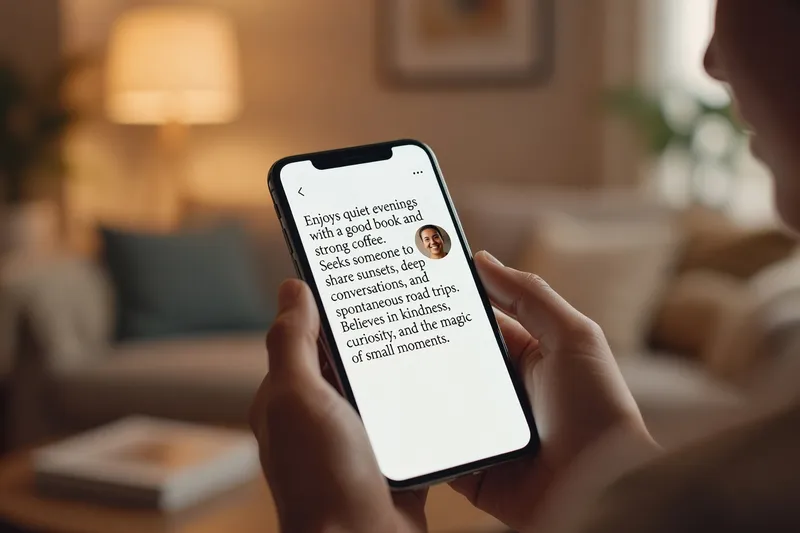
A specific, well-written bio does part of the conversational work before a single message is exchanged.
How to Write a Profile That Attracts the Right Kind of Attention
A profile is the one piece of the dating app experience an introvert fully controls, and it is worth treating it that way. The goal is not to perform extroversion you don’t have — it’s to write something specific enough that it does some of the conversational work for you before a single message is exchanged.
Start with specificity over broad claims. “I like reading and travel” describes millions of profiles and gives a potential match nothing to grab onto. “I’ve read the entire Murderbot Diaries series twice and I will debate you about which planet from the books I’d actually want to live on” gives someone an immediate, concrete hook. The more specific the detail, the easier it is for the right kind of person to message you with something worth responding to, and the less small talk you’ll need to generate yourself.
Consider directly and briefly mentioning that you’re more introverted, framed positively rather than apologetically. Something like “I recharge with quiet nights in and one-on-one conversations over big group nights out” sets accurate expectations and pre-filters for people whose social pace matches yours. This alone eliminates a category of mismatched conversations before they start.
Use structured prompts wherever the platform offers them instead of leaving them blank or answering generically. Prompts exist specifically to reduce the improvisation required from whoever messages you first — a well-answered prompt is essentially a pre-written conversation starter that someone else can pick up and run with, which shifts some of the initial social effort off your plate.
If you want a deeper walkthrough of the exact structure that produces the best response rates — including which sections matter most and which common mistakes quietly kill interest — how to write a dating profile that reflects who you actually are covers the full framework with real before-and-after examples.
Managing Message Volume Without Burning Out
Even on a well-chosen platform, message volume can spike unpredictably — a profile update, an algorithm boost, or simply a lucky week can produce more matches than you expected. Having a system for managing that volume protects your energy without requiring you to ignore people or feel guilty about response times.
Set a fixed daily or twice-daily window for checking and replying to messages rather than responding in real time throughout the day. Constant notifications create a background hum of social obligation that is exhausting even when you’re not actively typing. Batching your replies into one or two focused sessions turns dating app messaging into a bounded task instead of an open-ended one.
Prioritize ruthlessly. Not every match deserves equal time. If a conversation has stalled into repetitive small talk after several exchanges with no forward motion, it is reasonable to let it go rather than keeping it alive out of politeness. Your energy is a finite resource, and spending it on a conversation with no momentum is energy not spent on one that might actually lead somewhere.
It’s also fine — and often necessary — to be honest about your pace. A simple, friendly “I tend to reply once a day rather than instantly, just so you know” removes the pressure of feeling like you owe someone an immediate response, and it filters out anyone who can’t tolerate a slower rhythm, which is useful information early rather than late.
When to Suggest a Video Call Instead of Endless Texting
Text conversations can drag on for weeks without ever resolving into a real sense of whether there’s chemistry, and for introverts, that extended texting phase can become its own drain — a low-grade obligation that never quite ends. A short video call, introduced at the right moment, often resolves more uncertainty in fifteen minutes than another week of back-and-forth messaging.
The right moment is usually after four to six meaningful exchanges, once you have a sense that the conversation has some substance but before it has calcified into a routine that neither person wants to disrupt. Suggesting a call at this point is not aggressive or presumptuous — it is efficient, and most people on dating apps, introverted or not, appreciate a partner who moves things forward with intention.
Frame the suggestion casually and with a low-pressure exit built in: “Would you be up for a quick video call sometime this week? No pressure if texting is more your speed for now.” This respects the other person’s pace while giving you the option to gather much more information — tone of voice, actual conversational rhythm, real-time reactions — than text alone can ever provide.
For introverts specifically, a video call can actually be less draining than an in-person first date, since it removes the logistics of travel, the sensory overload of a public venue, and the harder-to-exit nature of a face-to-face meeting. A call that isn’t going well can end naturally after fifteen minutes; a bad first date at a restaurant can stretch uncomfortably for an hour or more.

A fifteen-minute call can end naturally if it isn't working, which a restaurant dinner rarely allows.
Red Flags That Waste an Introvert’s Limited Social Energy
Because introverts have a smaller daily budget of social energy to spend on dating, it’s worth being especially alert to patterns that predictably waste that budget without producing anything in return.
The message hoarder. Someone who keeps a conversation going indefinitely without ever suggesting a call or a meeting is often more interested in the low-stakes attention of texting than in an actual relationship. If weeks pass with no forward motion despite your attempts to suggest one, that is useful information, not a reason to try harder.
The interrogator. A match who sends a rapid string of questions without offering anything about themselves in return creates an asymmetric conversation that puts all the effort on you. Good conversations, even early ones, involve mutual disclosure. One-sided interviews are a red flag regardless of how flattering the attention initially feels.
The over-scheduler. Someone who wants to move from match to multiple-times-a-week phone calls or texting marathons within days is often looking for a pace that will exhaust an introvert quickly, regardless of actual compatibility. It’s reasonable to name your pace directly rather than trying to match theirs and burning out within two weeks.
The vague profile with high message volume. Profiles with almost no specific information but a high frequency of matches or messages often indicate either low effort or, in some cases, automated or semi-automated accounts. If you can’t find anything concrete to respond to across several exchanges, that thinness is itself informative — for a deeper breakdown of how to distinguish genuine low-effort profiles from something more deliberately deceptive, our guide on spotting fake dating profiles walks through the specific signals worth watching for.
The platform mismatch. If you consistently find yourself exhausted by the app itself rather than by any individual match, that’s a sign the platform’s structure — not your dating approach — is the problem. It may be worth comparing how different apps actually function; for instance, how Tinder’s swipe mechanics compare for serious daters is a useful reference point if you’re trying to decide whether a high-volume platform is worth the trade-off for your particular goals.
Building a Sustainable Weekly Dating Routine
The single most useful shift for introverted daters is treating dating apps as a scheduled, bounded activity rather than an ambient, always-on background task. A sustainable routine might look like: 20 to 30 minutes in the morning to review new matches and send a small number of thoughtful opening messages, a similar window in the evening to reply to ongoing conversations, and the rest of the day free of app notifications entirely.
Limit yourself to one primary platform, or at most two if you have a specific reason to maintain both. Every additional app multiplies the number of simultaneous conversations you’re expected to sustain, which is precisely the kind of social overhead that drains introverted daters fastest. Consolidating effort onto a single well-chosen platform, rather than spreading thin across four or five, tends to produce better outcomes and less fatigue.
Build in deliberate off-weeks. Taking a full week away from a dating app every four to six weeks is not a failure of discipline — it’s basic energy management, and it tends to make the weeks you are active more focused and effective, since you’re not running on a depleted reserve. Many platforms let you pause visibility without losing your profile or match history, which makes this easy to do without starting from zero each time.
Finally, if you’re weighing which platform deserves your limited time and attention in the first place, it’s worth comparing options directly rather than guessing. The full list of top 10 dating sites we recommend ranks platforms across categories including match quality, pricing, and user base size, which can help you settle on one primary app instead of spreading your energy across several.
None of this requires becoming a different kind of person to succeed at online dating. It requires choosing tools and habits that work with your actual temperament rather than against it — fewer, better conversations instead of more, shallower ones. For introverts, that shift alone tends to make the entire process feel less like an obligation and considerably more like something worth doing.
For readers researching international or cross-cultural dating platforms as part of that same selective approach, a French-language guide to serious online dating platforms offers an additional comparative perspective on platforms oriented toward more intentional, less casual dating.
Frequently Asked Questions
Are dating apps bad for introverts? Not inherently, but high-volume swipe apps designed around constant novelty can overwhelm introverts. Apps with personality-based matching, longer profiles, or lower daily match caps tend to work better because they reduce decision fatigue and encourage deeper first conversations.
Which dating app is best for shy or introverted people? Platforms that emphasize compatibility questionnaires and structured icebreakers over rapid swiping — such as Hily’s personality-driven matching — tend to suit introverts better than pure swipe-based apps, since they front-load context and reduce small talk pressure.
How many dating apps should an introvert use at once? One, or at most two. Managing multiple apps multiplies the number of conversations to sustain simultaneously, which is precisely the kind of social overhead that drains introverted daters fastest.
Is it okay to take breaks from dating apps as an introvert? Yes, and it’s recommended. Scheduling deliberate off-weeks prevents burnout and keeps the profile and messages you do send more thoughtful, which improves response quality even if it slightly reduces volume.
Should introverts mention being introverted in their dating profile? A brief, confident mention can work well — it pre-filters for compatible matches and sets expectations for pacing. Framing it positively (e.g., “I recharge with quiet evenings and one-on-one time”) reads better than an apologetic disclaimer.