
Long-distance relationships have existed as long as people have had reasons to live apart. What changed is how they start. In 2026, a growing proportion of LDRs are not formed when two people in the same city drift apart — they begin as a first swipe, a chat window, a video call, and a decision to keep talking despite hundreds or thousands of miles between them.
This shift matters because it inverts the traditional LDR challenge. Classic long-distance is about maintaining what already existed in person. Online-to-LDR is about building something that has only existed through a screen and transforming it into something real. The practical and emotional work is different, and most generic relationship advice does not account for it.
This guide covers every stage: from the first weeks of connection through video calls, to the first in-person meeting, managing time zones, recognizing warning signs, and ultimately closing the distance for good. Whether you are 200 miles or 8 time zones apart, the principles here apply.
The Rise of Long-Distance Relationships Born Online
The trend is undeniable. Many couples who initially connect online find themselves in long-distance relationships when they first meet. This has become more common as international dating platforms grow and remote work makes it easier for people to overcome geographic limitations in their professional lives.
- International Dating Platforms: More accessible, verified, and trusted than five years ago. Choosing the right platform is crucial, as detailed in our ranked guide to the top 10 dating sites for 2026.
- Improved Video Call Quality: Reduces psychological distance, making online relationships feel more intimate than some in-person first dates.
- Remote Work: Enables geographic flexibility, making it feasible for couples to consider living in each other’s city.
Second, video call quality has improved dramatically. The psychological distance that once made online relationships feel inherently fragile has narrowed. Couples regularly describe their early FaceTime routines as more intimate than many in-person first dates they experienced before.
Third, remote work has created a generation of people who genuinely can ask “would we be willing to live in each other’s city?” without it being an absurd question. Geographic flexibility has made the logistics of closing the distance more realistic than at any point in recent history.
According to research published in the Journal of Communication, long-distance couples report higher levels of idealization, quality communication, and trust than geographically close couples in many measurable categories. The data challenges the assumption that distance is automatically a disadvantage.
The First 30 Days: Building Trust Before You Meet
The first month of a long-distance online relationship sets the tone for everything that follows. It is a period of low verifiable information — you are building a picture of someone almost entirely from what they choose to share — which makes the calibration of trust both more important and more challenging.
The most common mistake couples make in this phase is mistaking volume for depth. Messaging constantly throughout the day creates an illusion of intimacy that may not reflect the actual person. What builds real trust is consistency over time: someone who shows up when they say they will, who follows through on small commitments, who behaves the same way on a Tuesday at 7 PM as on a Saturday at midnight.
- Reliability of Video Calls: Do they video call reliably, or frequently cancel?
- Real Life Integration: Are you introduced to their apartment, commute, friends, or does every call feel managed?
- Consistency: Are there inconsistencies between what they say and what becomes visible over time?
The first month is also when emotional investment accelerates fastest. Set a deliberate pace. This does not mean being guarded or cold — genuine warmth and enthusiasm are healthy. It means making sure you are building on real observations rather than projections. The person you are getting to know is constructed partly by them and partly by your imagination filling in the gaps. Keep the ratio weighted toward actual evidence.
Video Call Strategy: Frequency, Duration, and Avoiding Burnout
Video calls are the structural spine of an online LDR. They are where you read tone, body language, and the small visual cues that text cannot carry. They are also where most couples make their first major tactical mistakes.
The two most common errors are calling too much and calling with no agenda. Daily calls lasting two or three hours feel romantic at first. Within weeks, they become a drain. One or both people is tired, half-present, running out of things to say, and increasingly dreading a call that was supposed to feel like a highlight of the day. This is not a sign of incompatibility — it is a structural problem with the format.
A sustainable rhythm for most couples is four to five scheduled calls per week, with a duration of 45 to 90 minutes. The word “scheduled” is important. Spontaneous calls have their place, but the backbone of your communication routine should be predictable. Knowing that Thursday at 9 PM is your call reduces the ambient anxiety of wondering whether you will connect today.
Build variety into the call format. Not every call should be a face-to-face conversation about your feelings. Cook dinner together on video. Watch a documentary simultaneously. Play an online game. Do a virtual museum tour. These shared experiences create relationship texture that pure conversation struggles to build.
One specific practice that consistently improves LDR call quality: end each call with a brief preview of the next one. “On Saturday, I want to show you the neighborhood where I grew up” gives both people something to look forward to and frames the next call as an event rather than a check-in.
Making the First In-Person Meeting Count
The first meeting is the moment the relationship either confirms or revises itself. Almost every LDR couple describes a version of the same phenomenon: the first hour is strange, almost awkward, because the body is adjusting to the physical reality of someone it knows deeply but has never actually touched.
This initial strangeness is normal and should not be interpreted as a bad sign. Give it 24 to 48 hours before drawing any conclusions. The second day of a first visit almost always feels dramatically more natural than the first.
Plan the first visit with intention, but do not over-plan it. The goal is not to execute a perfect itinerary — it is to discover what being in the same physical space actually feels like. Include some downtime, some ordinary activities, and some moments where nothing specific is happening. How you are together in unstructured time is more revealing than how you are together at a restaurant or a tourist attraction.
Before traveling to meet someone from an online relationship for the first time, review the online dating safety guide — it includes practical pre-meeting verification steps, safe logistics advice, and what to do if your instincts signal something wrong. These precautions are not pessimistic; they are the infrastructure that makes confident first meetings possible.
The first visit should ideally be at least four to five days. Shorter than that and the adjustment period takes up most of the available time. Longer is better if both parties can manage it. By the end of a five-day visit, you will know more about the real relationship than you learned in three months of video calls.
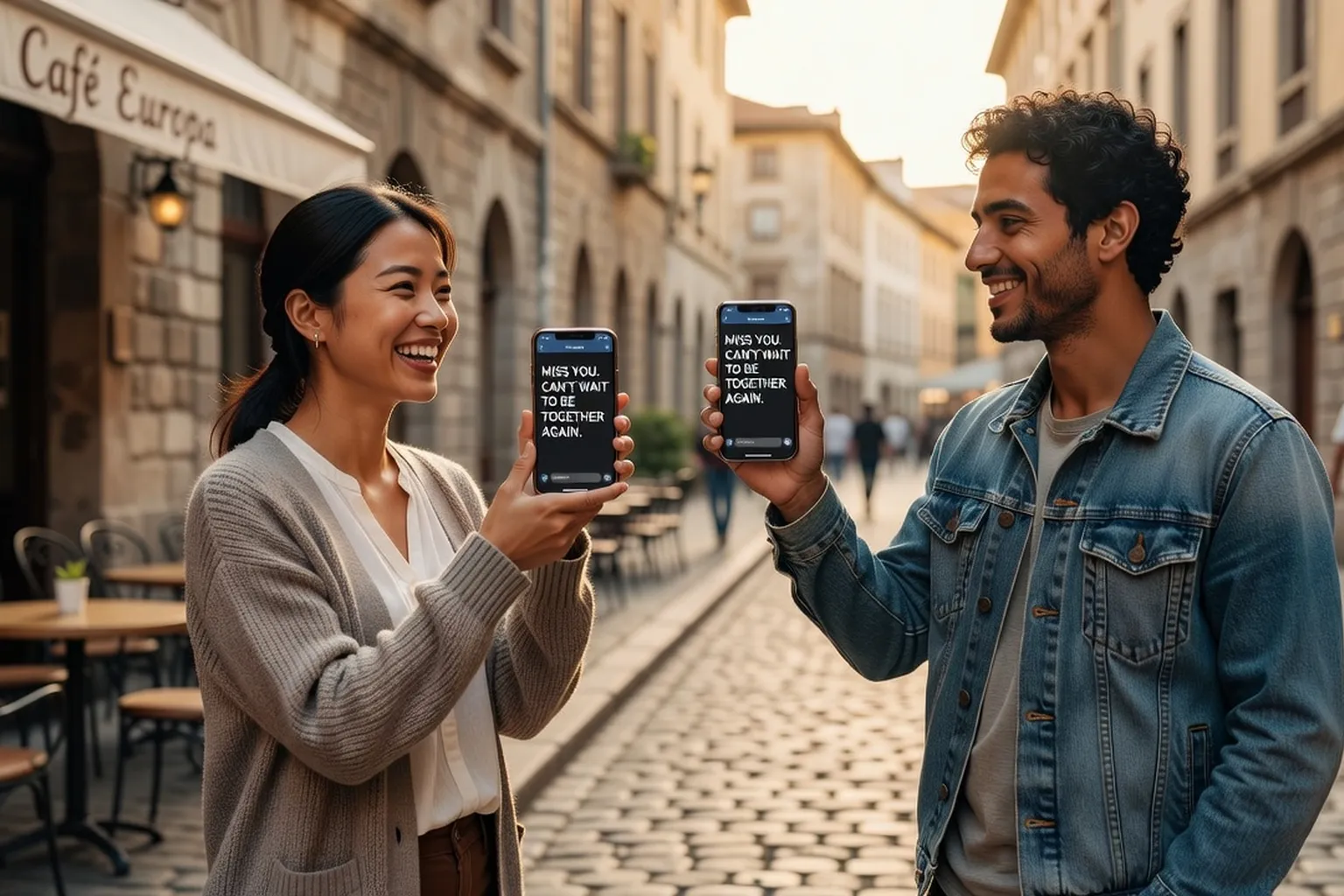
The first meeting carries the weight of everything the screen could not convey about presence.
Managing Time Zones, Schedules, and Communication Gaps
Time zones are one of the most consistently underestimated sources of friction in LDRs. A four-hour difference is manageable with coordination. An eight-hour difference means that your morning is the other person’s evening, and any overlapping window requires someone to give up comfortable hours consistently.
The solution is not to pretend the asymmetry does not exist — it is to acknowledge it explicitly and rotate the sacrifice deliberately. If one person always takes the inconvenient call time, resentment accumulates. Alternate who schedules calls at their peak hours. Make the accommodation visible and appreciated.
Communication gap management requires a shared framework. Agree explicitly on response time expectations. If one person treats a message as requiring an immediate reply and the other treats messages as things to respond to when time allows, the mismatch generates anxiety disproportionate to the actual situation. Most conflicts in LDRs that appear to be about one partner “not caring enough” are actually about unaligned expectations around response speed.
For the psychological dimensions of managing distance and the emotional patterns that emerge in cross-cultural online relationships, the interview with Dr. Emma Walters on international online dating psychology covers attachment styles, idealization risks, and the emotional rhythms that characterize LDRs more deeply than most practical guides do.
One practical system that works well: a shared digital space — a private Notion workspace, a shared Google Doc, or an app like Couple — where both partners can drop thoughts, ideas, and updates throughout the day without the expectation of immediate response. This keeps the connection alive during gaps without creating pressure for constant availability.
The LDR Toolkit: Best Apps and Tools in 2026
The infrastructure of a modern LDR is more sophisticated than it was even three years ago. These are the tools that couples consistently report as genuinely useful, not just theoretically nice to have.
WhatsApp and iMessage remain the workhorses of daily LDR communication. Reactions, voice notes, and the ability to share location temporarily are all features that couples use daily. Voice notes in particular deserve more credit than they get — a two-minute voice note carries tone and warmth that even the most carefully worded text message cannot replicate.
Locket Widget has become one of the most-recommended LDR apps since its update in 2024. It places your partner’s photos directly on your phone’s home screen widget, creating a small persistent visual presence that many couples describe as meaningfully reducing the sense of absence.
Couple (the app, not the concept) provides a private two-person space with a shared timeline, a thumb-kiss feature, and private messages. It is particularly valued by couples who want a communication channel that exists separately from the general noise of their phones.
Facetime SharePlay and Netflix Party (Teleparty) allow synchronous media consumption. Watching a show or a film together at the same time, with the ability to react to each other in real time, is a surprisingly powerful shared experience generator. Many LDR couples maintain a shared Netflix watchlist as a running feature of their relationship.
Flighty and TripIt are flight tracking apps that many LDR couples use to share travel plans and track each other’s journeys. There is something concretely reassuring about watching your partner’s flight in real time on a shared itinerary.
Warning Signs Your LDR Is Not Healthy
The same distance that builds communication discipline in healthy LDRs can also mask or amplify dysfunction. These are the patterns worth watching for.
- Unequal Accommodation: If calls, timing, and visit logistics require sacrifice from one person consistently, the dynamic needs examination.
- No Plan for Closing the Distance: Relationships over twelve months without a timeline for closing the distance may be stagnant.
- Escalating Jealousy and Control: Constant check-ins and demands for location updates indicate underlying trust issues.
- Existence Only in Calls: If neither partner integrates the other into their actual life, the relationship may lack depth.
No concrete plan for closing the distance. A relationship that has been long-distance for more than twelve months with no agreed timeline for changing that status is, statistically, more likely to be a holding pattern than a genuine path toward a shared future. Both partners should be able to articulate what “closing the distance” looks like and roughly when.
Jealousy and control escalating around the distance. Requests for constant check-ins, demands to know exactly where the other person is at all times, and anger when calls are missed are patterns that the structure of LDR can amplify. These are not distance problems — they are attachment and trust problems that happen to be expressed through the mechanics of distance.
The relationship only exists in the call. If neither partner is integrating the other into their actual life — mentioning them to friends, showing them to family, including them in plans for the future — the relationship may be functioning more as emotional support than as a genuine shared project.
When and How to Have the “Closing the Distance” Conversation
This conversation is the most important one in any LDR, and most couples avoid having it explicitly for as long as possible. The avoidance is understandable — the conversation forces clarity that may reveal uncomfortable incompatibilities. But relationships that lack clarity on this question tend to drift rather than progress.
The right time to have this conversation is earlier than you think. It does not need to be resolved in the first month, but it should be on the table as a genuine discussion within the first few months of serious connection. By the time you have met in person and confirmed real compatibility, you should have a working answer to “what does our future actually look like?”
- Desire to Close the Distance: Does each person genuinely want to close the distance, or is the relationship comfortable because it is long-distance?
- Realistic Constraints: Consider career, family, visa eligibility, and financial capacity.
- Timeline with Milestones: Establish an actual timeline with clear milestones for closing the distance.
For international LDRs especially, this conversation requires additional specificity about visa options and legal pathways. Anyone navigating this for the first time should also be aware that international dating contexts carry higher rates of romance scams — reading up on how to spot fake dating profiles and common patterns used to exploit LDR situations is a worthwhile protective step before making significant financial or logistical commitments.

Closing the distance across borders involves legal steps that take months, and researching early is rarely wasted.
International LDR: Visa, Immigration, and Practical Logistics
For couples separated by international borders, the path to closing the distance involves legal and bureaucratic steps that can take months to years. Starting this research early is almost always the right move, even if the relationship has not yet reached the stage where a formal commitment exists.
The most common visa pathways for international couples vary by country, but the major categories are partner/spousal visas, fiancé(e) visas (such as the K-1 in the United States), and long-stay visitor visas while a permanent pathway is in progress. Each has different requirements around proof of relationship, financial sponsorship, and processing timelines.
Several practical steps apply regardless of the specific pathway. Keep records of your shared history: dated screenshots of early conversations, receipts from visits, photos with metadata, and any formal correspondence. These records become evidence in visa applications and can significantly speed up processing when they are well-organized.
Cost is a significant variable. International visits for an LDR couple typically run between $1,500 and $5,000 per trip once airfare, accommodation, and activities are included. Two to three visits per year is a common cadence for established couples, which represents a real ongoing financial commitment that should be factored into planning conversations early.
Latin American partners in particular often navigate their own specific set of visa complexities, and connecting through platforms focused on international matching in that region can provide community support alongside romantic matching — Latin American singles on international long-distance dating platforms can be a useful starting point for both connection and practical shared experience with the logistics involved.
Success Stories: What Long-Distance Online Couples Say
The patterns in successful online-origin LDRs are consistent enough to function as useful guidance.
Couples who make it tend to have started their relationship with deliberate intention rather than drifting into it. They noticed early that the distance was going to require extra effort and made a mutual decision to invest that effort rather than hoping circumstances would resolve naturally.
They maintained honesty about the difficulty. The couples that struggle most are those who treat every expression of loneliness or frustration as a threat to the relationship. The ones who succeed tend to have established early that saying “this is hard today” is not the same as saying “I don’t want this anymore.” Normalizing the difficulty reduces its power to destabilize.
They treated visits as relationship infrastructure rather than vacations. Every visit was used not just for enjoyment but for advancing the couple’s knowledge of each other in real life — meeting each other’s people, seeing each other in their home environments, doing ordinary things alongside the special ones.
And uniformly, the couples who successfully closed the distance describe the same turning point: the moment they stopped thinking of themselves as long-distance and started thinking of themselves as a couple who happened to currently live in different places. That psychological shift — from “this is a limitation we are managing” to “this is a temporary circumstance we are solving” — changed their daily experience of the relationship.
The distance is not the relationship. It is the context in which the relationship is happening. That distinction, simple as it sounds, is often the difference between couples who endure long-distance and those who eventually stop.